Buying a home in Gurugram is not one decision. It is a chain of legal, financial, technical and everyday-living decisions—and a weak link in any one of them can become expensive later.
The safest sequence is simple: verify first, negotiate second and transfer money last. A polished sample flat or an urgent “last unit” message should never compress your diligence window.
1. Identify exactly what is being sold
Write down the project name, phase, tower, unit number, floor, property type, parking allocation and promised possession status. Marketing names can cover several phases with different approvals and completion dates. Your paperwork must refer to the same legal project and phase you inspected.
2. Search the project on Haryana RERA
Use the official Haryana RERA portal—not a screenshot supplied over messaging. Compare the promoter, registration number, sanctioned plans, declared completion date and uploaded project documents. If the project or phase should be registered but cannot be found, pause and obtain independent legal advice.
3. Match the promoter and land-owning entity
The brand selling a project may not be the entity that owns the land or signs the agreement. Ask how the developer, landowner and special-purpose company are connected. Your lawyer should review title records, development rights, collaboration agreements and encumbrances relevant to the transaction.
4. Check planning and land-use permissions
For plotted, low-rise or unusual mixed-use products, verify the sanctioned use rather than inferring it from nearby construction. The Haryana Town and Country Planning Department publishes statutory documents and planning services. A residential-looking structure is not proof that every use or floor is sanctioned.
5. Read the sanctioned plan—not only the brochure
Compare unit orientation, tower spacing, access roads, common areas, service zones, fire access and future phases. A brochure illustrates intent; sanctioned drawings and the agreement define what can be relied upon.
6. Confirm the area basis
Ask for carpet area, balcony or terrace area and any other chargeable area separately. RERA uses carpet area as a defined measure. “Super area” can be useful for comparison only when its components are clearly explained and applied consistently.
7. Review the agreement before paying a large amount
The agreement should identify the unit, price, payment schedule, possession terms, specifications, delay provisions, cancellation consequences and allocation of taxes or statutory charges. Do not rely on verbal assurances that are absent from the signed document.
8. Verify the seller in a resale
Match the seller’s identity with the title documents and confirm authority where a representative or power of attorney is involved. Review the chain of title, previous agreement or conveyance deed, loan closure, society or maintenance dues and restrictions on transfer.
9. Understand possession and completion documents
“Ready”, “near possession” and “families moving in” are not interchangeable legal statuses. Ask which competent authority issued the occupation or completion document, what it covers and whether your tower and unit fall within it.
10. Build an all-in cost sheet
Add the base consideration, parking if separately permitted, statutory charges, applicable tax, stamp duty, registration, maintenance deposits, club or facility charges, utility deposits, brokerage, legal review, loan costs and fit-out. Mark every item as fixed, estimated, refundable or recurring.
11. Check tax withholding before scheduling payment
Property-purchase tax obligations differ according to value and whether the seller is resident or non-resident. Obtain advice before releasing funds; correcting an incorrect deduction after registration can be time-consuming.
12. Inspect the physical unit and building systems
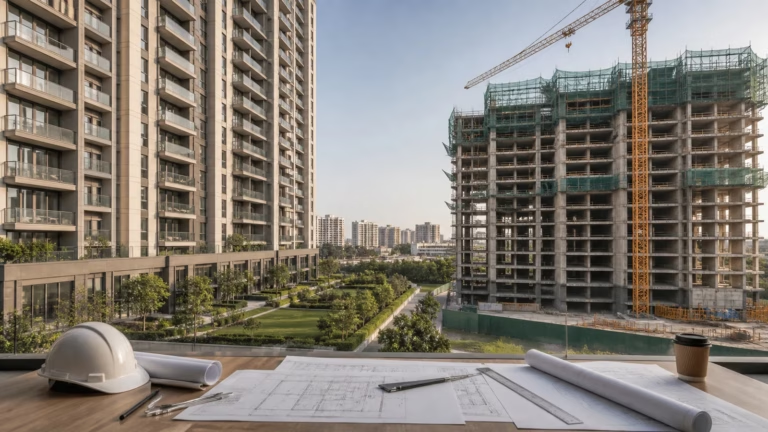
For completed homes, check seepage, window sealing, plumbing pressure, electrical points, HVAC provisions, lift condition, fire systems, basement access and parking dimensions. Record defects in writing with dated photographs.
13. Visit the neighbourhood at three different times
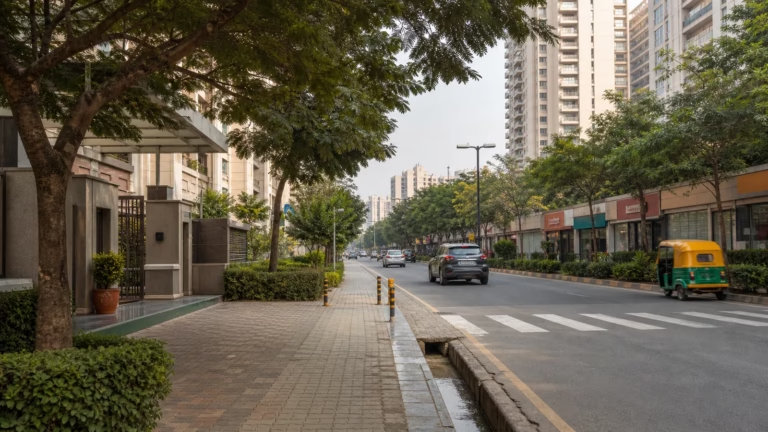
Inspect on a weekday morning, evening peak and after dark. Observe last-mile traffic, road condition, drainage, lighting, construction noise, daily retail, emergency access and the real travel time to places that matter to you.
14. Understand recurring ownership costs
Ask for the maintenance formula, sinking or replacement reserves, power-backup tariff, club charges and recent increases in an operating development. Large landscapes, pools, façades and mechanical systems need funding long after handover.
15. Preserve a clean decision record
Keep the advertisement, cost sheet, application, receipts, email commitments, RERA record, plans and signed documents together. Pay only to the verified account stated in formal paperwork and insist on a receipt.
A sensible final rule
No single document proves that a purchase is safe. Confidence comes from consistency: the portal record, title review, sanctioned use, physical unit, contract and payment trail should all describe the same transaction.
This article provides general information, not legal, tax or investment advice. Rules and portal records can change; engage qualified professionals for a specific transaction.