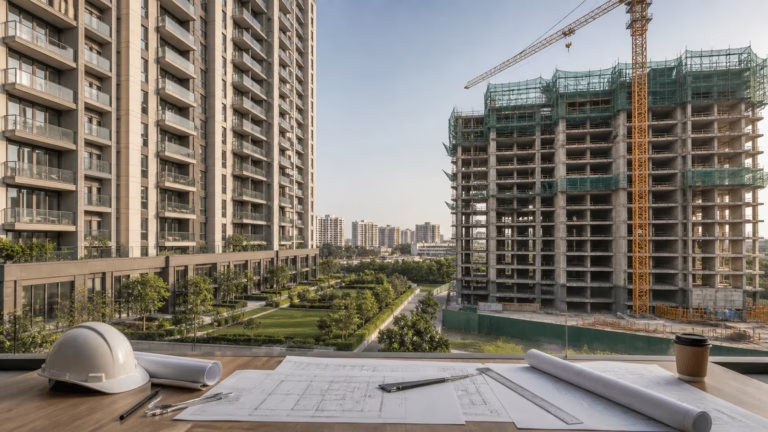
Commercial property is often marketed through a return percentage. A durable decision starts elsewhere: what legal interest are you buying, what use is permitted, who will occupy it, and what must the property earn after vacancy and operating costs?
Office, retail and shop-cum-office products have different demand drivers. They should not share one generic yield assumption.
Define the asset precisely
Record the unit, floor, chargeable and usable area, parking, signage rights, access, common areas and permitted use. Identify whether you are buying a completed conveyable unit, an under-construction allotment, a leased asset or another structure.
Review the exact project or phase on Haryana RERA where the law requires registration.
Verify title, licence and permitted use
An independent lawyer should examine title, encumbrances, development rights, licences, sanctioned plans and the authority of the seller. Confirm commercial land use and the activities permitted in the unit.
For SCO or plotted formats, do not infer buildable area, floor use, parking or signage rights from neighbouring properties. Compare the sanctioned framework and current state planning rules.
Examine tenant demand from the ground up
For office space, consider floor-plate efficiency, lift capacity, power, HVAC, parking, public transport, fit-out condition and the depth of employers in the catchment.
For retail, examine visibility, pedestrian and vehicle movement, frontage, entry sequence, tenant mix, delivery access and whether the catchment is occupied today.
For SCO, test which businesses can operate economically after construction, fit-out and ongoing charges—not only the flexibility implied by the format.
Normalise the rent
Separate base rent from common-area maintenance, tax, parking, fit-out recovery, utility reimbursements and incentives. Account for rent-free periods, brokerage, fit-out contribution and security deposit.
The effective rent may be lower than the face rent. Compare transactions with similar lease term, tenant quality, fit-out and responsibility for operating costs.
Underwrite vacancy and downtime
Model acquisition costs, fit-out, leasing commission, vacancy, repairs, maintenance during vacancy and the time required to find a new tenant. A quoted return based on continuous occupancy is not a complete investment case.
Ask who the next plausible tenant is and how many competing units are available in the same building and micro-market.
Review the lease, not only the tenant name
For a leased asset, review lease term, lock-in, escalation, deposit, renewal, termination, subletting, restoration, maintenance responsibility and default history. Confirm that rent has actually been received and reconcile tax and maintenance records.
A recognised tenant does not eliminate lease expiry or vacancy risk.
Inspect building operations
Check lifts, power redundancy, HVAC, fire systems, water, parking management, loading access, security and maintenance governance. Obtain current operating charges and recent increases.
In mixed-use property, study conflicts between office, retail, residential and event traffic. Visit during the business peak and after normal working hours.
Verify environmental and infrastructure context
Where applicable, review environmental-clearance information and conditions through the official portal. Inspect drainage, waste movement, access roads and planned infrastructure through relevant state and metropolitan authorities.
Build the exit case before buying
Commercial assets can have thinner resale markets than homes. Consider unit size, ticket value, remaining lease term, tenant concentration, building age and competing supply. Model an exit without assuming immediate liquidity or automatic capital appreciation.
The final investment memo
Before committing, write a one-page memo stating:
- legal asset and permitted use;
- all-in acquisition and fit-out cost;
- current and effective rent;
- stabilised operating expenses;
- vacancy and reletting assumptions;
- tenant and lease risks;
- three reasons a future buyer would choose the asset;
- three conditions that would make you walk away.
If the investment works only when every optimistic assumption is true, the return is not compensating for risk—it is hiding it.
This article is general information, not legal, tax or investment advice. Commercial-property structures and regulations require transaction-specific professional review.